Every month the Central Transmission Utility sends out a bill. It goes to states, discoms, generators, ports, cement plants, a metro system and a fertiliser company or two, and it covers the cost of the interstate wires that carried their power. In July 2026 that bill came to Rs 4,109 crore, the largest single month in the series.
Here's the odd part. The customers on that bill were holding 126,362 MW of interstate access between them, up from 100,993 MW when the series opens in February 2021. Divide one by the other and a megawatt of access cost Rs 3.25 lakh a month in July 2026. In February 2021, it cost Rs 3.34.
The grid got a quarter bigger. The unit price went down.
The bill that stopped growing
For four years the total ran uphill in a straight line. FY 2021-22 came in at Rs 41,029 crore, then 42,963, then 45,440, then 46,338 for FY 2024-25.
Then FY 2025-26 landed at Rs 46,225 crore. Fractionally below the year before. Not a collapse, not a policy shock, just a curve that reached its plateau and sat down.
Access kept rising through the same stretch, averaging 122,241 MW against 118,675 MW the year before. So the flat bill translates into a genuine fall in unit cost, from Rs 3.25 lakh per MW-month to Rs 3.15. New lines came into service, more customers turned up to share them, and the arithmetic did what arithmetic does.
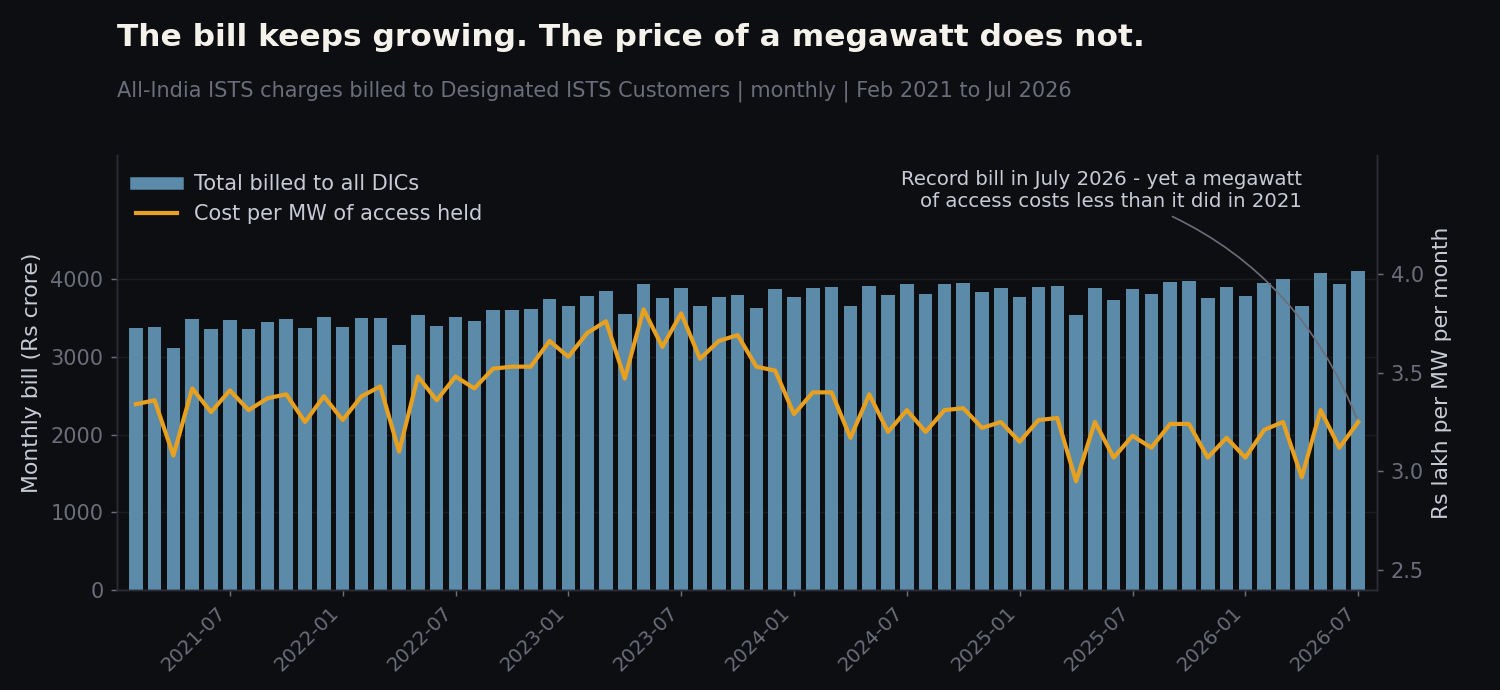 The blue bars are the total monthly bill. The amber line is what a megawatt of access costs. They have been drifting apart since mid-2023. Source: Wattfeed dashboard.
The seasonal sawtooth in that chart is not weather. April is the cheapest month almost every year, and February the dearest per day, because the annual charge is spread across months of unequal length. The grid is not resting in April. The calendar is.
One line item doing all the work
Break the bill into its seven components and six of them are doing nothing interesting. The bundled AC pool, the biggest single head, actually shrank across the period, from Rs 21,600 crore in FY 2021-22 to Rs 20,176 crore in FY 2025-26. Bilateral charges fell from 740 crore to 471. The transmission committee pool has grown 13 per cent in five years, which in this dataset counts as standing still.
Then there's the national committee's renewable energy pool.
That one was Rs 46.6 crore in February 2021. In July 2026 it was Rs 556 crore, up 57 per cent on the same month a year earlier and now 13.5 per cent of everything billed. Twelve times its starting value while the rest of the bill went sideways.
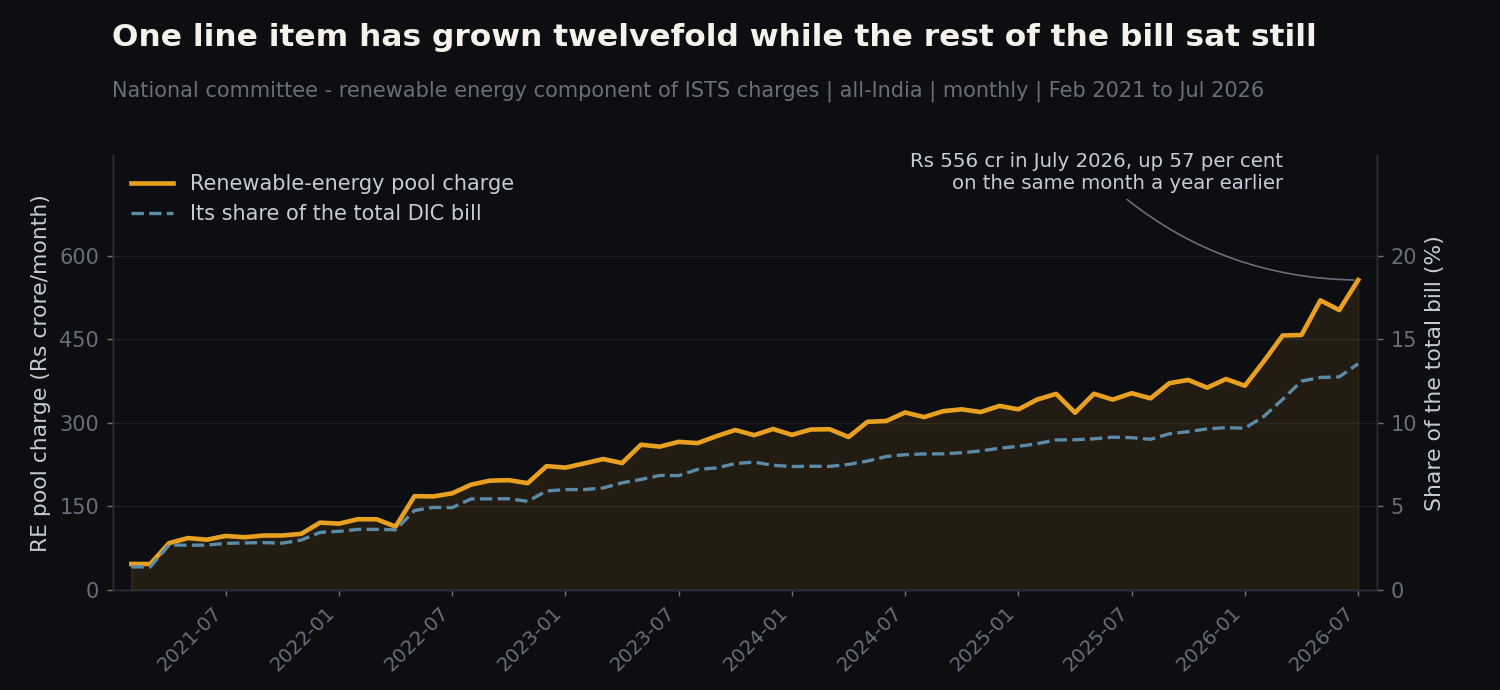 The RE pool in rupees and as a share of the total bill. The step change begins in early 2026. Source: Wattfeed dashboard.
This is the renewable buildout seen from the accounting side. Solar parks and wind clusters need evacuation corridors, those corridors get built, and the cost lands in a pool everybody on the interstate system contributes to. The line went nearly vertical from early 2026 onwards, adding close to Rs 190 crore of monthly charge in the six months to July.
Who pays, and who pays well
Uttar Pradesh pays the most. Rs 4,125.9 crore across FY 2025-26, a hair ahead of Gujarat at 4,009.5 and Maharashtra at 3,936.0. That ranking has been fairly stable: UP has topped the monthly table in 46 of the 66 reported months.
The obvious reason is size. UP held an average of 10,644 MW of interstate access last year, second only to Gujarat, and interstate charges are apportioned largely on the access you contract for rather than the energy you happen to take. Big state, big draw, big number at the bottom of the page.
What's more interesting is that UP is not an expensive place to hold that access. At Rs 3.23 lakh per MW-month it sits slightly below the national average. Gujarat, holding the largest block on the system at 12,628 MW, pays only Rs 2.65 lakh, one of the cheapest rates going. Chhattisgarh does better still at 2.50.
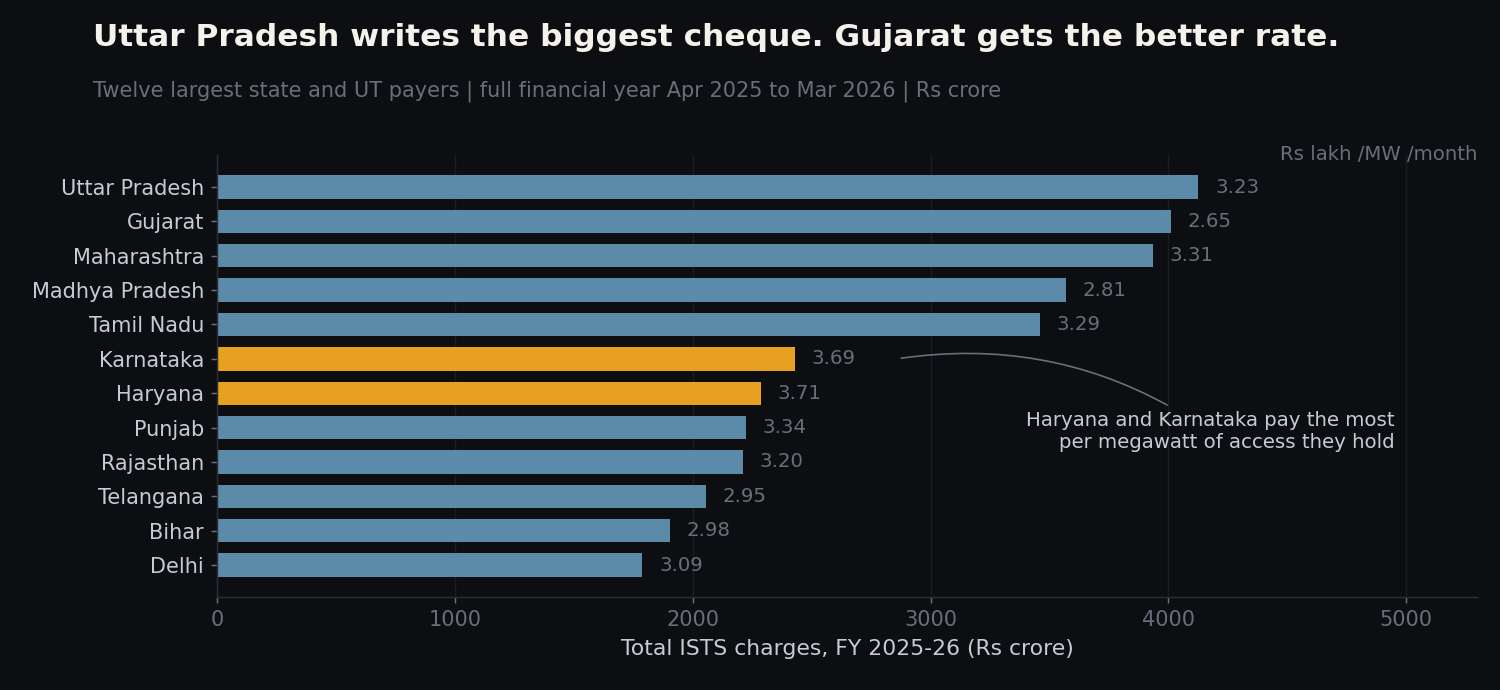 Total charges for the financial year, with the per-megawatt rate alongside. The two amber bars pay the steepest rate of the group. Source: Wattfeed dashboard.
The steep end belongs to Haryana at Rs 3.71 lakh and Karnataka at 3.69, both paying roughly 40 per cent more per megawatt than Gujarat does. Nagaland tops the whole table at 4.51, though on 145 MW that's a rounding error in national terms.
The reason sits outside the billing data, so treat it as mechanism rather than measurement: the sharing formula loads more onto customers who lean harder on the long-distance national network. Gujarat generates a great deal of what it consumes. Haryana and Karnataka import over distance, and the bill knows it.
What the wire is worth
For short-term buyers the charge shows up differently, as a rate per megawatt per 15-minute block. Averaged across states it was Rs 125.4 in July 2026, which for a buyer taking a full megawatt through the block works out to roughly 50 paise per kWh.
Set that against what the energy itself cost. IEX day-ahead cleared at an average of Rs 4,996 per MWh in July 2026, or just under Rs 5 a unit. The wire was about a tenth of the delivered cost.
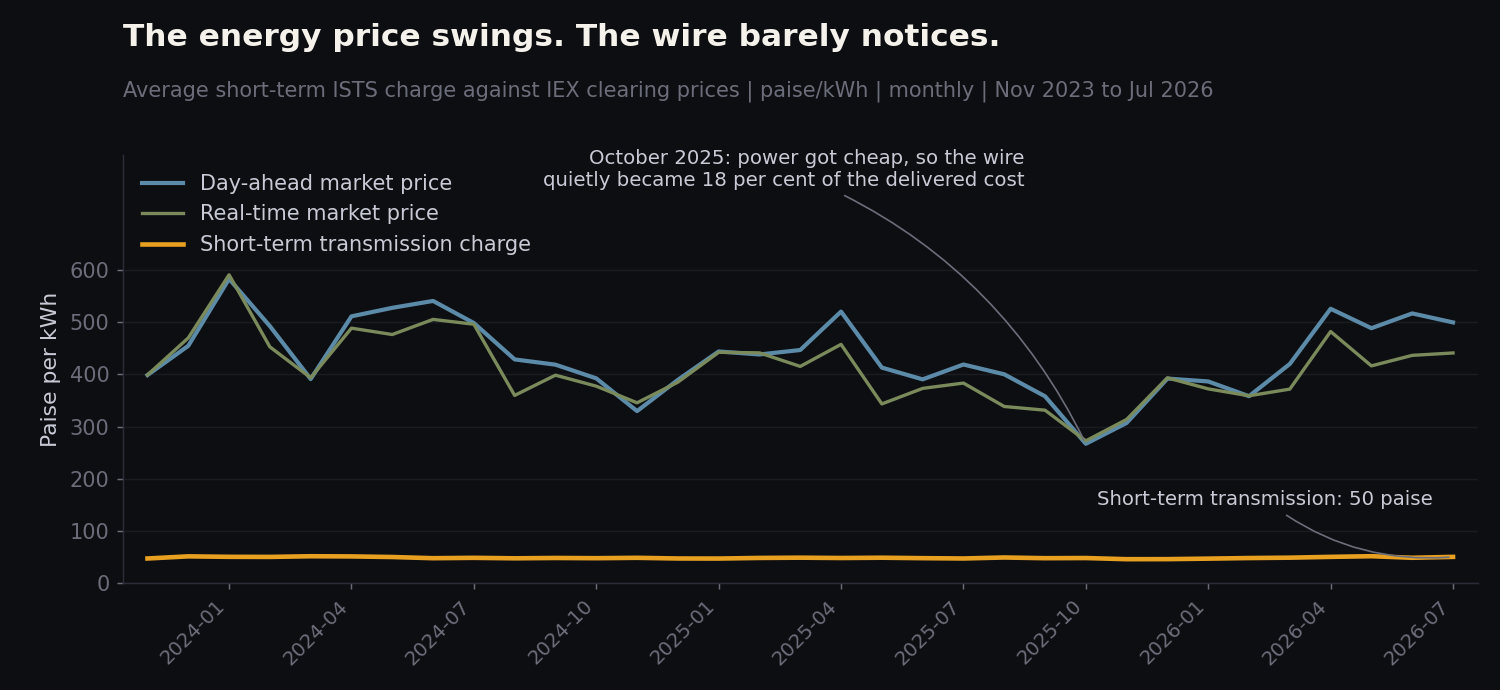 Everything converted to paise per kWh. The transmission line is the flat one at the bottom. Source: Wattfeed dashboard.
That tenth is not a constant, and not because the charge moves. Over nearly three years the short-term rate has stayed inside a band of roughly 45 to 52 paise. It is the market underneath it that heaves around. In October 2025, when day-ahead prices sagged to about Rs 2.67 a unit, the unmoved wire quietly grew to 18 per cent of what a buyer paid. By April 2026, with the market back above Rs 5, it was down to about 9.5 per cent.
So the transmission charge behaves less like a price and more like a floor. Cheap power makes it conspicuous. Expensive power hides it.
One more wrinkle worth knowing about. Not everyone on the list actually pays. In July 2026, 86 customers appeared in the waiver schedule, of whom eight had their interstate charges waived in full and another 50 partially. Delhi Metro, a clutch of ports, a few pharmaceutical and industrial buyers. The waiver is the policy lever that makes green open access viable for a corporate buyer, and it means the headline bill and the cash actually collected are not the same document.
Behind the customers sit the owners. In July 2026 the charge pool was split across 110 transmission licensees, and POWERGRID alone took 72.6 per cent of it. Of what those licensees claimed, about 0.4 per cent was trimmed before being allowed through, which is a remarkably quiet review process for a Rs 48,000 crore annual pot.
What happens next
The renewable pool is the thing to watch, and it is pointing in one direction. If it keeps even half the pace of the last six months, that component is close to Rs 700 crore a month by the end of FY 2026-27, and approaching a sixth of the total bill. Nothing else on the list is growing fast enough to dilute it.
The national bill will probably keep looking flat while doing nothing of the sort. Expect FY 2026-27 to land within a few per cent of FY 2025-26, with the mix underneath it redistributed toward the evacuation network.
The per-megawatt rate should keep easing gently. It has fallen in each of the last two financial years, and every new customer joining the pool spreads the same fixed costs a little thinner. A drift toward Rs 3.10 over the next year would be entirely in character, though the addition of a large new corridor can jolt the number in either direction inside a single month.
The state league table is genuinely up for grabs now. Uttar Pradesh led 46 of 66 months historically but only five of the last twelve, with Maharashtra matching it and Gujarat taking two. Across April to July 2026, Maharashtra is actually ahead on cumulative charges, 1,331 crore to 1,317. That's four months and a 1 per cent gap, so nobody should engrave anything yet.
And the waiver list will keep getting longer. It has gone from 64 names in January 2024 to 86 this July, adding a name every six weeks or so. Every corporate buyer signing a green open access contract adds another row.
The wires, meanwhile, will keep costing what they cost, indifferent to whether anyone finds that interesting.
All data used in this analysis can be found within the Wattfeed dashboard.