In February 2026, India sent 522 MU of electricity up into Bhutan. That is the largest single month of power India has ever pushed north across that border in twelve years of CEA records, and it happened in the same month India's own peak demand hit 244.2 GW, the highest February in the CEA record.
Take the whole dry quarter and it gets stranger. January through March 2026: 1,333 MU net, all of it flowing out of India and into Bhutan. Five years earlier, over the same three months, Bhutan sent 403 MU the other way.
The direction of the arrow reversed, and then the arrow got much bigger.
The dry season changed hands
The relationship used to be simple, and it ran one way. Bhutan's run-of-river hydro plants filled up with Himalayan meltwater and monsoon rain, Bhutan sold India the surplus, and India banked a tidy 5,000-odd MU a year for the privilege of being downstream. In 2014 the net figure was 5,113 MU into India. Nobody thought of it as a two-way arrangement, because for most of the year it wasn't.
Then the winters started going the other way. In January 2022, for the first time in the series, the January net turned negative. It was 62 MU, barely worth mentioning. By January 2024 it was 288 MU. By January 2026 it was 465 MU, and February beat that.
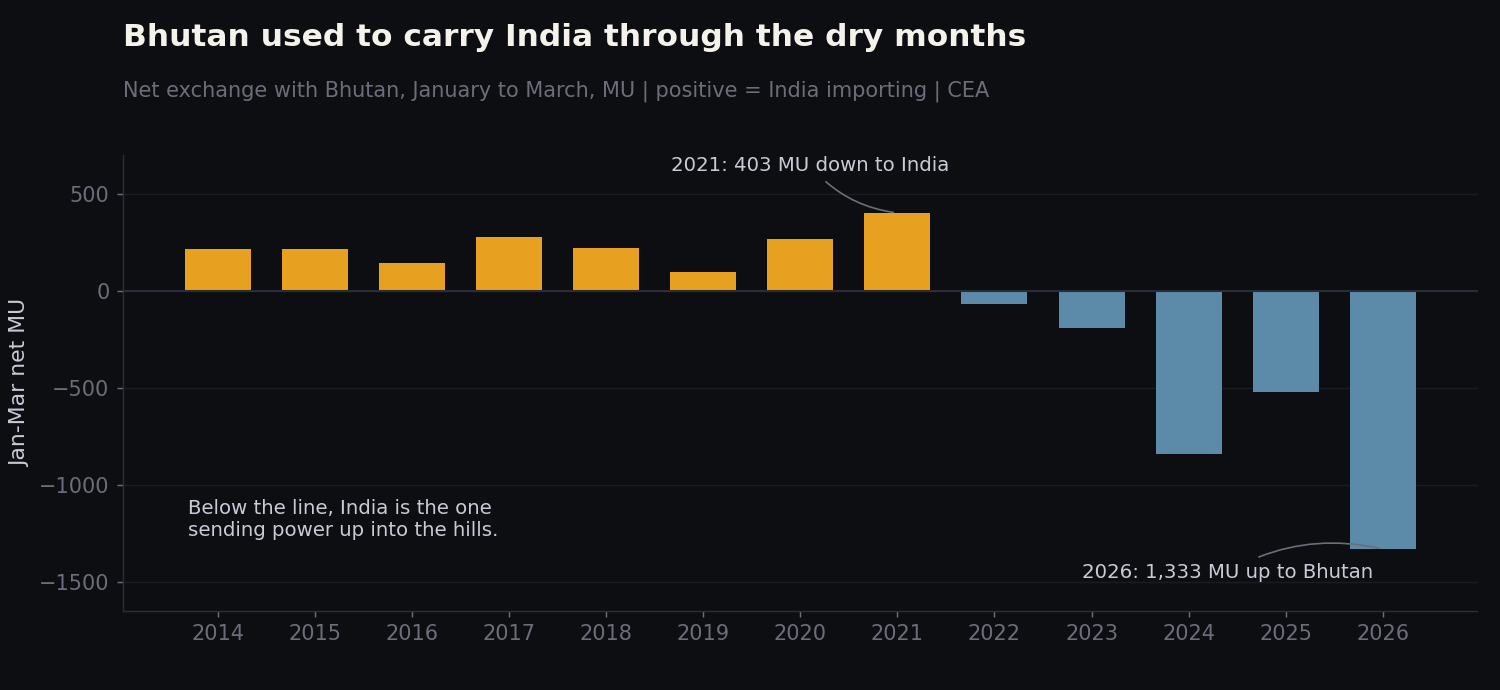 Net exchange with Bhutan across the January-March dry quarter. Positive means India importing. The sign flips in 2022 and the deficit has roughly tripled since. Source: Wattfeed dashboard.
The monsoon half of the deal, meanwhile, is in fine health. Bhutan sent India 5,875 MU across June to September 2025, the strongest monsoon since 2020, with August alone at 1,610 MU. So this is not a story about Bhutan running out of water. It is a story about a country whose entire generating fleet depends on rivers that shrink in winter, and whose demand does not shrink with them.
Why the hills go quiet
Run-of-river hydro is a lovely thing in July and a slightly awkward one in February. There is no big reservoir holding back a season's worth of water, so output tracks the flow in the river more or less honestly. Come the dry months, the rivers drop, the turbines slow, and somebody has to make up the difference. That somebody is on the other side of the 400 kV lines at Alipurduar and Binaguri.
Nepal is running the same script, one verse behind. For a decade Nepal was a straightforward buyer: 2,469 MU net in 2019, 2,206 MU in 2017, every year a deficit. Then the monsoon exports started landing. 2024 closed at 420 MU net into India, the first positive year in the series. 2025 closed at 1,789 MU, with October alone at 742 MU, the biggest month Nepal has ever sent south.
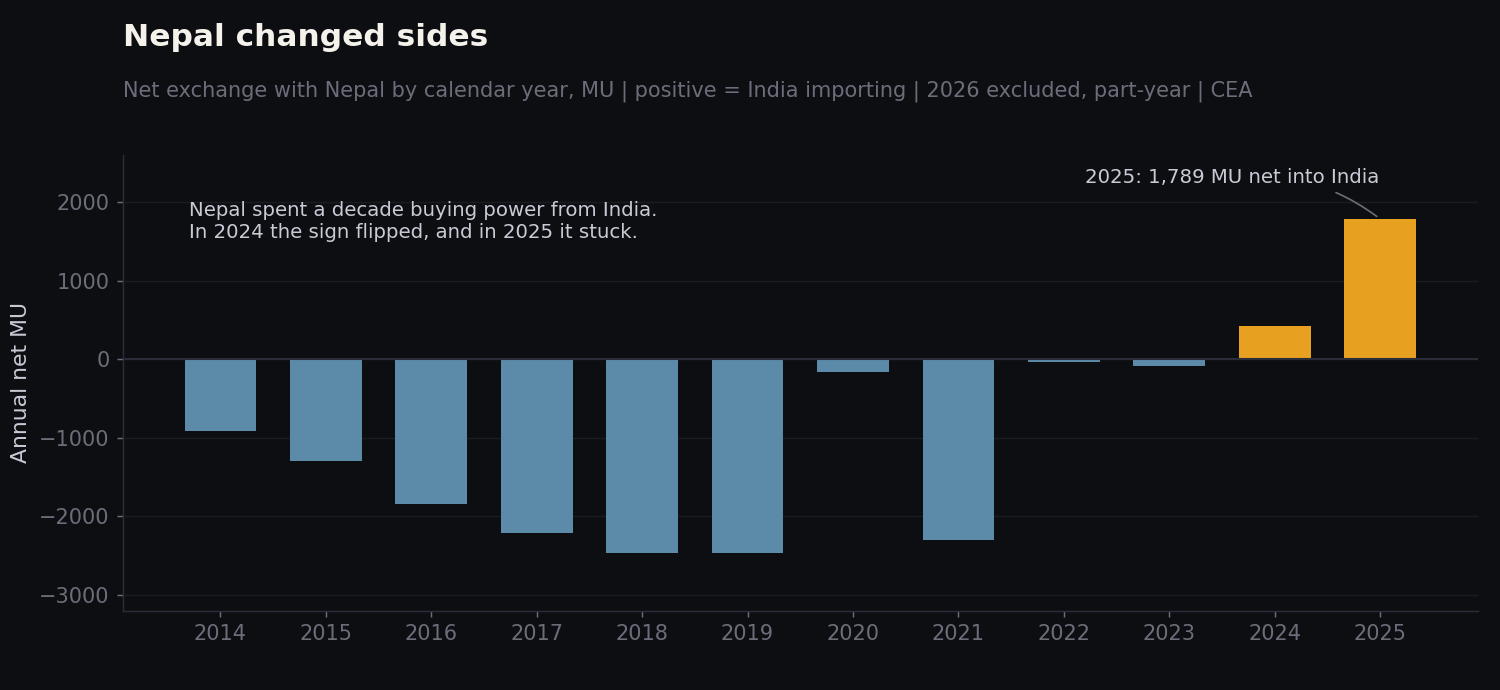 Annual net exchange with Nepal. 2026 is left off because only six months of it exist. Source: Wattfeed dashboard.
And then, right on cue, Nepal spent January to April 2026 buying 895 MU back from India before the rains arrived in May. Sell in October, buy in February. It is less a trading relationship than a very large seasonal overdraft, and India is the branch manager.
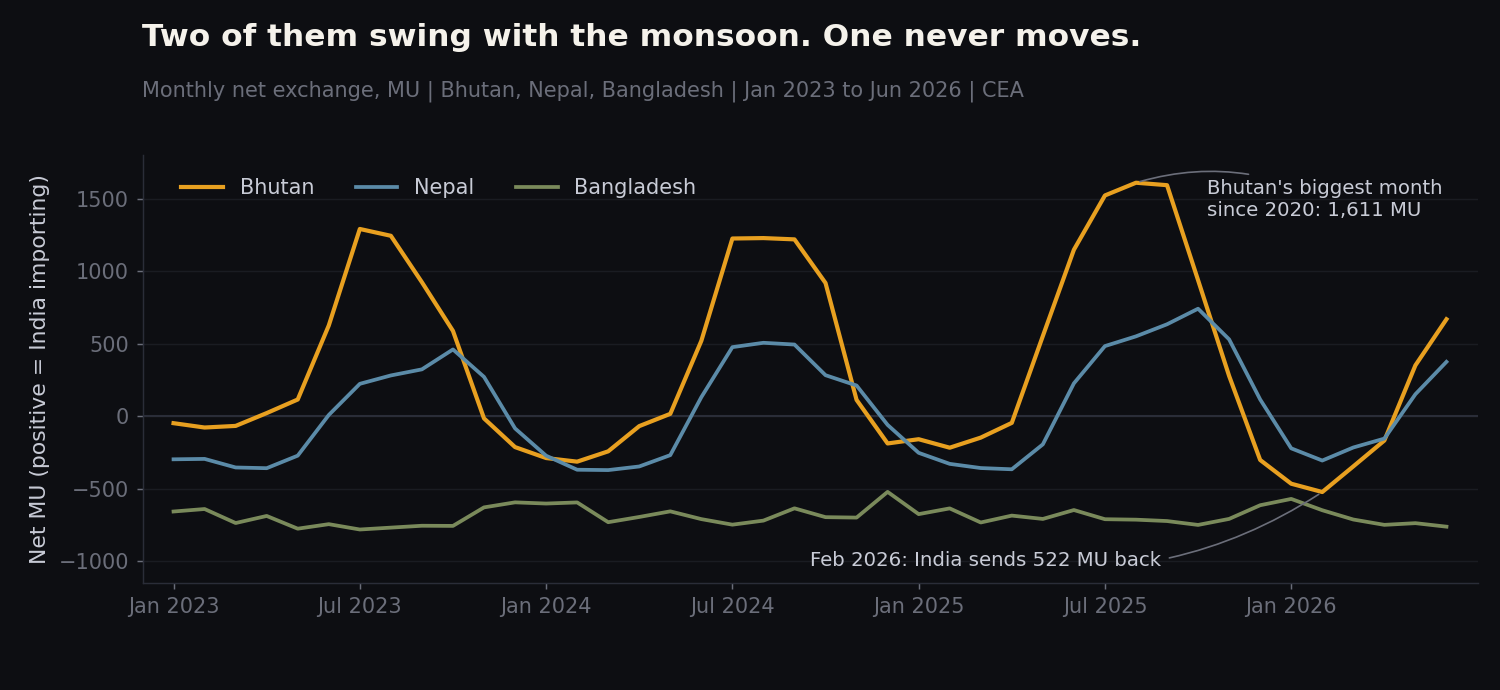 Bhutan and Nepal oscillate with the monsoon and cross zero twice a year. Bangladesh does not cross zero at all. Source: Wattfeed dashboard.
The neighbour who never wavers
Which brings us to the flattest line in South Asian power data.
Across 150 reported months since January 2014, India's net exchange with Bangladesh has been negative every single time. Not most months. Every month. Through the 2022 fuel-price squeeze, when India exported 8,309 MU to Bangladesh and August of that year touched 786 MU. Through 2023, which closed at 8,520 MU, the highest year in the series. Through the summer of 2026, when India's own peak demand touched 270.8 GW in May, the highest figure in the CEA record, and the Bangladesh links kept moving about 24 MU a day anyway.
The daily data makes the point better than the monthly does. Since January 2025, exports to Bangladesh have averaged 22.7 MU a day with a standard deviation of just 3.0. It is not a market relationship that breathes with the season. It is a metronome.
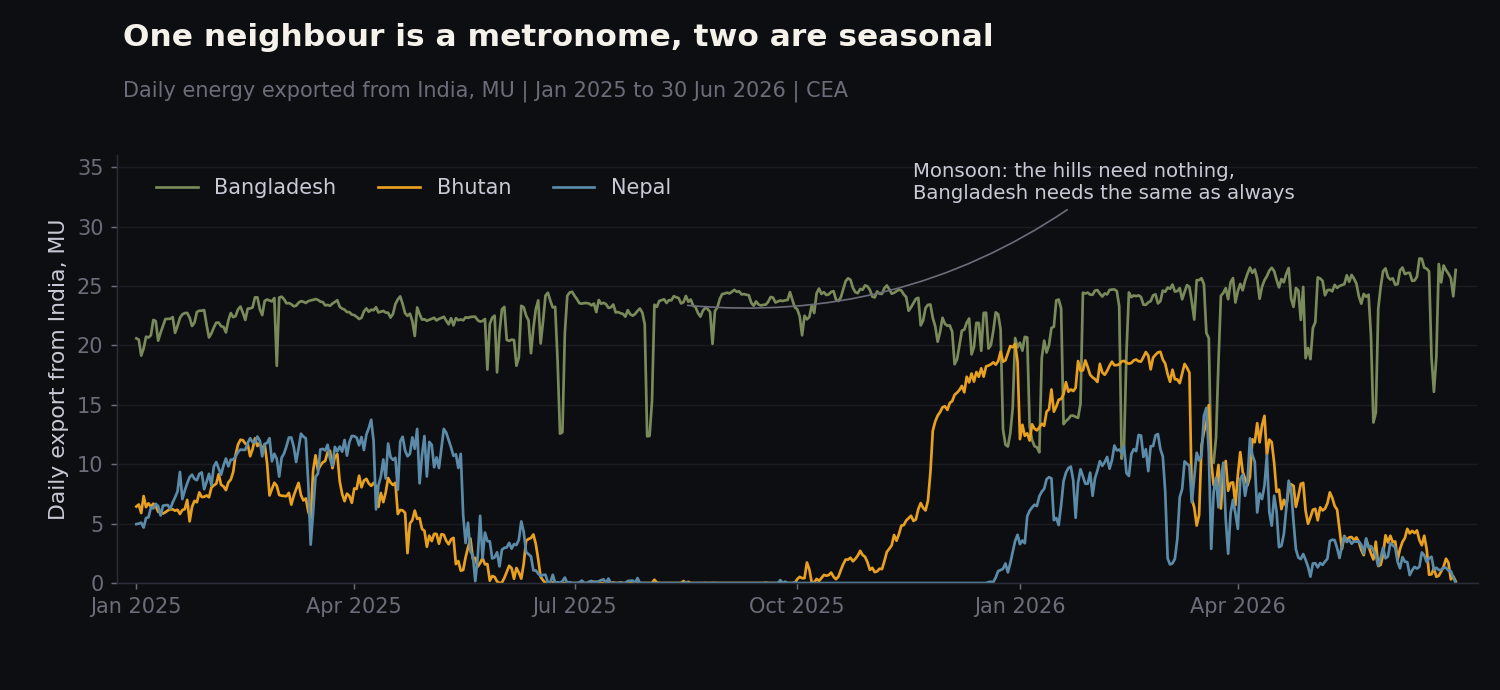 Daily exports from India. Bangladesh holds a near-constant band while the Bhutan and Nepal lines collapse to zero every monsoon and climb back every winter. Source: Wattfeed dashboard.
First half of 2026: 4,176 MU to Bangladesh, the second-largest January-to-June total in the series, behind the 4,239 MU of the same months in 2023. Whatever else is going on in the neighbourhood, that corridor does not notice.
And then there is Myanmar
Every family has one member who shows up to the reunion, eats a samosa, and leaves.
India's exchange with Myanmar runs over a single 11 kV line between Moreh and Tamu. The whole of 2025 came to 8.3 MU. That is not a typo, and the units are the same MU used everywhere else in this piece. India's Bangladesh corridor moves that much energy in roughly nine hours. The daily average across 2025 and the first half of 2026 is 0.02 MU, which is the sort of number that disappears if you round the rest of the page.
It is, however, the most consistent thing in the dataset after Bangladesh. Every reported month since 2016, the same tiny trickle. Somebody keeps that line energised, and somebody on the other end is glad they do.
What happens next
The 2027 dry quarter probably goes deeper still. The January-to-March deficit with Bhutan has grown in three of the last four years, from 191 MU in 2023 to 1,333 MU in 2026, and the jump into 2026 was the steepest of them. If that direction holds, next year's dry quarter clears 1,300 MU again and could reach 1,600, though a wet winter in the eastern Himalaya would take the edge off that in a hurry.
Nepal's full-year 2026 net should land positive again, and there is a decent case it beats 2025. The first half ran a 368 MU deficit against 1,269 MU over the same months of 2025, so the monsoon has a far smaller hole to fill before it starts building a surplus. June 2026 alone came in at 375 MU into India, against 227 MU in June 2025. The rains still have to show up, and they have made fools of better forecasters.
Bangladesh looks set for another 8,000-plus MU year on the first-half run rate, and on that corridor's twelve-year record of not caring what else is happening, the burden of proof sits firmly with anyone predicting otherwise.
The wider point is that the swing is widening at both ends. Across the twelve months to June 2026, the gap between India's biggest import month from Bhutan and its biggest export month to Bhutan came to 2,133 MU, the widest twelve-month spread in the series and a third more than the previous high. The grid is increasingly being asked to act as a seasonal battery for the whole subcontinent, soaking up meltwater in August and paying it back in February. That is a genuinely useful thing to be. It is also, as any older sibling will tell you, extremely difficult to ever stop being.
All data used in this analysis can be found within the Wattfeed dashboard.